How to Write a Job Description That Actually Attracts Talent (2026 Template)
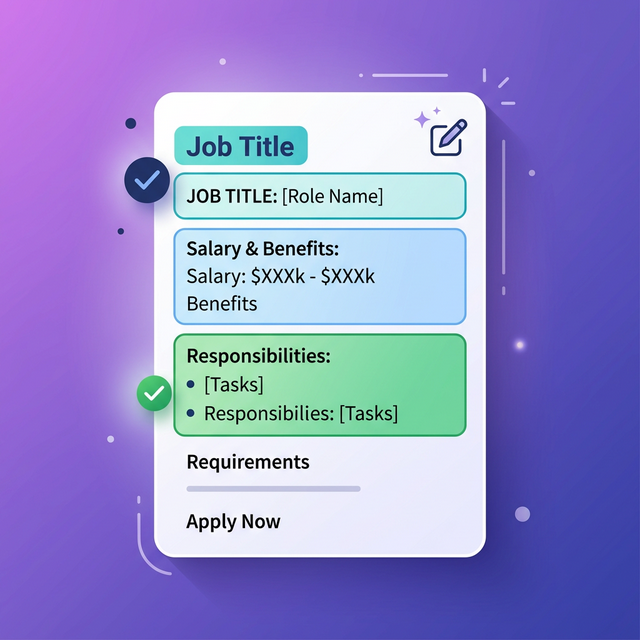
You wrote a job description. You posted it. You waited.
Nothing happened.
No applicants. No shares. Just silence. Sound familiar?
Here is the uncomfortable truth: most job descriptions are written for HR compliance, not for humans. They read like legal contracts, bury the salary at the bottom (or omit it entirely), and look identical to every other post on the internet.
In 2026, the competition for talent is brutal. You are not just competing with other employers — you are competing with every Instagram story, TikTok video, and WhatsApp message fighting for your ideal candidate's attention.
This guide gives you the exact formula to write job descriptions that rank on Google, get shared on social media, and convert browsers into applicants.
Why Most Job Descriptions Fail
Before we fix yours, let's diagnose the problem. Most job posts fail for one (or all) of these reasons:
- No Salary = No Clicks. Studies show that job posts with a visible salary range get up to 75% more clicks. If you are hiding compensation, candidates assume the worst.
- Wall of Text. A 1,500-word essay about your company's "dynamic culture" makes candidates close the tab. The 3-second rule applies: if the candidate cannot answer "What is the role?", "Who is hiring?", and "What does it pay?" in 3 seconds, they scroll past.
- Generic Titles. "Ninja Rockstar Developer" tells Google nothing. Search engines cannot rank what they cannot understand. Use real job titles that people actually search for.
- Ugly Distribution. Sharing a
forms.gle/xyzlink on WhatsApp or LinkedIn produces zero visual preview. It looks like spam. Visual job cards consistently outperform text links by 3x in click-through rates.
The Anatomy of a Perfect Job Description
Here is the structure that top-performing job posts follow. Think of it as a recipe — skip an ingredient, and the dish falls flat.
1. The Title (Your SEO Headline)
Your title is the single most important line. It determines whether Google indexes you, whether candidates click, and whether your post gets shared.
Rules:
- Use the exact title candidates search for. "Senior React Developer" beats "Code Wizard III."
- Include seniority level when possible (Junior, Mid, Senior, Lead).
- Keep it under 60 characters so it does not get truncated in search results.
Good Examples:
- ✅ Senior Graphic Designer — Remote
- ✅ Marketing Manager (Social Media Focus)
- ✅ Full Stack Developer — React + Node.js
Bad Examples:
- ❌ HIRING!! Amazing Opportunity!!!
- ❌ Rockstar Sales Ninja
- ❌ Team Member
2. The Hook (First 2 Sentences)
This is your elevator pitch. Not your company history. Not your mission statement.
Answer ONE question: Why should a talented person care about this role?
"We are scaling from 10 to 50 customers this quarter and need a Growth Marketer who wants to own the entire funnel — from first ad to closed deal."
Compare that to:
"Founded in 2018, we are a leading provider of innovative SaaS solutions in the B2B space..."
The first version makes the candidate feel the urgency and the opportunity. The second sounds like every other company on the planet.
3. Compensation (Put It First, Not Last)
This is non-negotiable in 2026. Multiple jurisdictions now legally require salary transparency (Colorado, New York City, California, EU Pay Transparency Directive).
Even where it is not required, posting salary is strategic:
| Metric | With Salary | Without Salary | |---|---|---| | Click-through rate | 75% higher | Baseline | | Application completion | 65% higher | Baseline | | Candidate quality match | High (self-filtering) | Low (mismatched expectations) | | Time-to-hire | Faster | Slower (salary negotiation friction) |
Format it clearly:
- "$80,000 – $110,000/year + equity"
- "$40–$60/hour (contract)"
- "₹8L – ₹15L per annum"
4. Responsibilities (5-7 Bullets, Action Verbs)
Keep it to 5-7 bullet points. Each should start with an action verb.
- ✅ "Lead the redesign of our customer onboarding flow"
- ✅ "Own the Instagram and TikTok content calendar"
- ❌ "Will be responsible for various tasks as assigned"
- ❌ "Works with cross-functional teams on synergistic deliverables"
Pro Tip: Frame responsibilities as outcomes, not tasks. "Increase organic traffic by 30% in 6 months" is more exciting than "Write blog posts."
5. Requirements (Must-Have vs. Nice-to-Have)
This is where most companies accidentally filter out great candidates. Research shows that women apply only if they meet 100% of requirements, while men apply at 60%.
Split your requirements into two clear sections:
Must-Have (Non-Negotiable):
- 3+ years of experience with React and TypeScript
- Portfolio with at least 2 shipped products
Nice-to-Have (Bonus Points):
- Experience with Next.js or Remix
- Familiarity with Figma or design systems
This small change can increase your female applicant pool by 20-30%.
6. Benefits and Perks (Sell the Lifestyle)
Don't just list "health insurance" and "PTO." Every company has those. Highlight what makes you different:
- 🌍 "Work from anywhere — we have team members in 12 countries"
- 📚 "$2,000/year learning budget (conferences, courses, books)"
- 🏖️ "Unlimited PTO with a 15-day minimum (we mean it)"
- 🎨 "Creative Fridays — 20% time for personal projects"
7. The Application CTA (Reduce Friction to Zero)
This is where most hiring pipelines break. You wrote a great description, the candidate is excited, and then you send them to... a clunky Google Form that requires sign-in.
The best CTAs are:
- One link. Not "email your resume to hr@company.com AND fill out this form AND connect on LinkedIn."
- Mobile-friendly. 58% of job searches happen on mobile. If your application form does not work on a phone, you lose half your candidates.
- Visual. When shared on WhatsApp or Slack, the link should render a preview image — not a bare URL.
Senior React Developer
This is what candidates see when you share a GigDrop link on social media.
The Complete Job Description Template
Copy this template and fill in the brackets:
[Job Title] — [Remote / Location]
Compensation: [Salary Range] + [Equity/Bonus/Benefits]
[2-sentence hook: Why is this role exciting? What will the person achieve?]
About [Company Name] [2-3 sentences. What do you do? How big is the team? What stage are you at?]
What You Will Do:
- [Responsibility 1 — outcome-focused]
- [Responsibility 2]
- [Responsibility 3]
- [Responsibility 4]
- [Responsibility 5]
Must-Have:
- [Hard requirement 1]
- [Hard requirement 2]
- [Hard requirement 3]
Nice-to-Have:
- [Bonus skill 1]
- [Bonus skill 2]
Why Join Us:
- [Unique perk 1]
- [Unique perk 2]
- [Unique perk 3]
How to Apply: [Single, direct link to your application — ideally a visual, mobile-first experience]
Where to Post It (For Maximum Reach)
Writing the description is only half the battle. You need to distribute it where your ideal candidates actually spend time.
Check out our full guide: Where to Post Jobs for Free in 2026 for a detailed breakdown of the 10 best platforms.
Quick distribution checklist:
- Your own branded link — Use GigDrop to create a visual card and get a shareable URL.
- LinkedIn — Still the king for professional roles.
- WhatsApp / Telegram Groups — Where informal hiring happens at scale. Stop using Google Forms for this.
- Instagram Stories — Perfect for creative roles. Here is how to do it right.
- Niche communities — Slack groups, Discord servers, subreddits.
Common Mistakes to Avoid
- "We are like a family." This is a red flag for most candidates in 2026. It implies no boundaries.
- Listing 15+ requirements. You are describing a unicorn that does not exist.
- No salary. We covered this. Just post it.
- "Competitive salary." This means "we do not want to say." Candidates interpret it as "low."
- Requiring a cover letter. Unless you are hiring a writer, this adds unnecessary friction. Most candidates skip postings that require one.
- Using a survey form as your application. Typeform, JotForm, and Google Forms were not built for hiring. Use a tool designed for recruitment.
Go From Description to Live Job Card in 60 Seconds
You have the template. You know what to write. Now you need the fastest way to turn it into a professional, shareable job post.
GigDrop lets you:
- Paste your job description
- Auto-generate a visual social media card
- Get a branded, mobile-first application link
- Manage all applicants in a built-in dashboard — no spreadsheets needed
Growth Marketer
From description to shareable card in under 60 seconds.
Create your job post now — it's free →
Summary
The best job descriptions in 2026 follow a simple formula:
- Clear title that people actually search for
- Salary upfront — transparency wins
- Hook first, company history second
- 5-7 responsibilities framed as outcomes
- Split requirements into must-have vs. nice-to-have
- Sell the lifestyle, not just the job
- One-click apply on a mobile-first, visual platform
Stop writing job descriptions for your legal team. Start writing them for the humans you want to hire.